Family meal planning for busy weeks and different appetites
By The Citron team
Start family meal planning with who will be home and how much time you have to cook each night. Choose familiar meals, adjust portions to your household, and give leftovers a specific place in the week. Keep sauces and toppings separate when preferences differ, and leave a backup dinner for the night that changes.
Start with the calendar before choosing recipes
Write down who needs dinner each evening, who can prepare it and when it needs to be ready. Count anyone eating later, too. If one adult works a late shift, their dinner still belongs in the plan.
Count the time from starting dinner to putting it on the table. A recipe with 15 minutes of prep and 45 minutes in the oven needs an hour in your evening. If you have 20 minutes between getting home and leaving for practice, choose something you already know fits that window. Check thawing, preheating and batch cooking before putting a recipe on a busy night.
Look in the refrigerator and freezer before filling the remaining slots. Write down what needs using soon and how much of each frozen meal is actually there. Then choose recipes.
Match your shopping day to the cooking day, too. The FoodSafety.gov cold storage chart gives raw poultry and ground meat only 1 to 2 days in the refrigerator. For a later dinner, buy them closer to the day or freeze them promptly and allow time to thaw in the refrigerator.
This approach also appears in The Family Meal Project's planning guide, which starts with food at home and the week's schedule. In the example below, each batch also has a serving count and a note about who will eat it.
A family week with time limits and assigned leftovers
Here's a sample week for two adults and two school-age kids. It's a template, not a week we cooked, so swap in your own recipes. It covers dinners plus two adult lunches made from dinner leftovers. Add other lunches, breakfasts and snacks to your shopping list separately.
In this example, the family's usual recipes feed everyone at four servings. The minutes show how much time there is that evening, not how long a recipe takes. Pick recipes that fit.
| Day | Who needs dinner | Time available | What goes in the plan | Where the extra food goes |
|---|---|---|---|---|
| Monday | All four | 40 minutes | A familiar meal made for six servings | Four servings for dinner; reserve two for the adults' Tuesday lunches |
| Tuesday | All four, before practice | 15 minutes | Four portions assembled from ready-to-eat ingredients already on the shopping list | No extra portions promised |
| Wednesday | Three at the table; one adult home late | 30 minutes | A familiar four-serving meal with sauce served separately | Refrigerate the late adult's serving promptly; it is tonight's dinner, not tomorrow's lunch |
| Thursday | All four, after a late pickup | 20 minutes | Four portions of an earlier freezer meal, moved to the fridge Wednesday morning | Check the portions before the week starts; allow enough thawing and reheating time for that meal |
| Friday | All four eating away from home | No cooking at home | No dinner ingredients to buy for this slot | Keep the backup dinner for another night |
| Saturday | All four | 60 minutes | A familiar meal made for eight servings, only if the recipe and pans fit the available time | Eat four servings; cool and freeze four promptly for next week's busy night |
| Sunday | All four | 30 minutes | A familiar four-serving meal using ingredients still on hand | Check the fridge and make next week's plan |
Choose one backup dinner that everyone can assemble or heat within your shortest evening slot. Check its package directions and buy enough for the household. In this example, it is separate from Thursday's four reserved freezer portions.
If making six servings takes more than Monday's 40 minutes, pick a simpler recipe or plan different Tuesday lunches. Doubling a recipe can mean a second pan or another batch. Keep the oven temperature and doneness instructions from the recipe; more food does not mean doubling the cooking time.
Count dinner portions and planned leftovers separately
Use a familiar recipe's yield as your starting point. If a recipe labeled four servings usually feeds your family with the sides you serve, that is a useful shopping estimate. If everyone asks for more, plan a larger batch next time. There is no need to assign every child a fixed fraction of an adult serving.
Monday's arithmetic is 4 dinner servings + 2 lunch servings = 6 servings. For a recipe that originally makes four, the ingredient multiplier is 6 ÷ 4 = 1.5. An ingredient measured as 2 cups becomes 3 cups, in the same preparation state: dry stays dry and cooked stays cooked. You still need to check whether the larger batch fits Monday's cooking window.
Write the two lunches into the plan before shopping. Set them aside in containers before serving dinner, then refrigerate promptly. If dinner needs those portions after all, change Tuesday's lunch plan. The same food cannot cover both meals.
Keep a note with each recipe about how much your family ate. You might finish a four-serving pasta dish but have soup left from a recipe with the same serving count. When a child wants a smaller plate, start with less and keep more available. The shopping estimate is not a rule about how much anyone must eat.
Plan for preferences before the food reaches the table
Ask each person for one dinner they would like this week. Fit those requests around the busy nights, and write down any change that affects the ingredients or cooking. "Sauce on the side" is more useful on the plan than "make it kid-friendly."
University of Utah Health's family meal guidance suggests adaptable meals, a familiar food at dinner and a neutral response when children reject a food. You can use those ideas without making a separate dinner for every preference.
| Preference in this household | Change to write on the plan |
|---|---|
| One child dislikes sauce touching the rest of the meal | Set aside their cooked portion before combining the dish; offer sauce separately |
| One person likes more heat | Keep the shared meal mild and add hot sauce at the table |
| Someone wants the ingredients separate | Serve the same cooked components side by side |
| One person avoids a main ingredient | Choose a recipe with an alternative they already eat, and include its quantity and cooking step before shopping |
These are ways to handle preferences, not allergy substitutions. If the alternative needs another pan or extra cooking time, count that work in the evening's time limit.
Keep something familiar available with the meal and let children decide what to eat from what is served. Save the new recipe for an evening when you have time to adjust it.
Give leftovers a date and a meal
Label each container with what is inside, the cooking date, how many portions it holds and its intended meal. "Two portions, Tuesday lunch" prevents someone counting Monday's extras toward Thursday's dinner.
FoodSafety.gov advises putting leftovers in shallow containers and refrigerating promptly, within 2 hours, or within 1 hour when exposed to temperatures above 90°F. Keep the refrigerator at 40°F or below and the freezer at 0°F or below. See its cooling and refrigeration guidance.
Its cold storage chart gives soups, stews and cooked meat or poultry leftovers 3 to 4 days in the refrigerator. If one of those foods is meant for a meal more than 3 to 4 days away, cool those portions promptly in shallow containers in the refrigerator, then freeze them for that later meal. Follow food-specific storage guidance and package instructions for other items.
For Wednesday's late adult, refrigerate the reserved serving instead of leaving it on the table. Reheat leftovers to 165°F, checking with a food thermometer, as listed in the FoodSafety.gov temperature chart. A planned 20-minute dinner still needs enough time to heat through.
When the week changes, check the food before moving the meal
If practice runs late or someone eats elsewhere, use the backup dinner or reduce that evening's cooking. Before moving the unused meal to another day, check its ingredients and storage dates. Freeze what can be frozen while it is still suitable, or move it to an earlier meal.
On Sunday, note which meal ran out, which left more than expected and which took too long. Use those notes to change how much you cook or which night you cook it next week. If a freezer meal saved Thursday, replace it when you next have room to cook extra, as Saturday does in the example.
Put your saved family recipes on Citron's meal plan
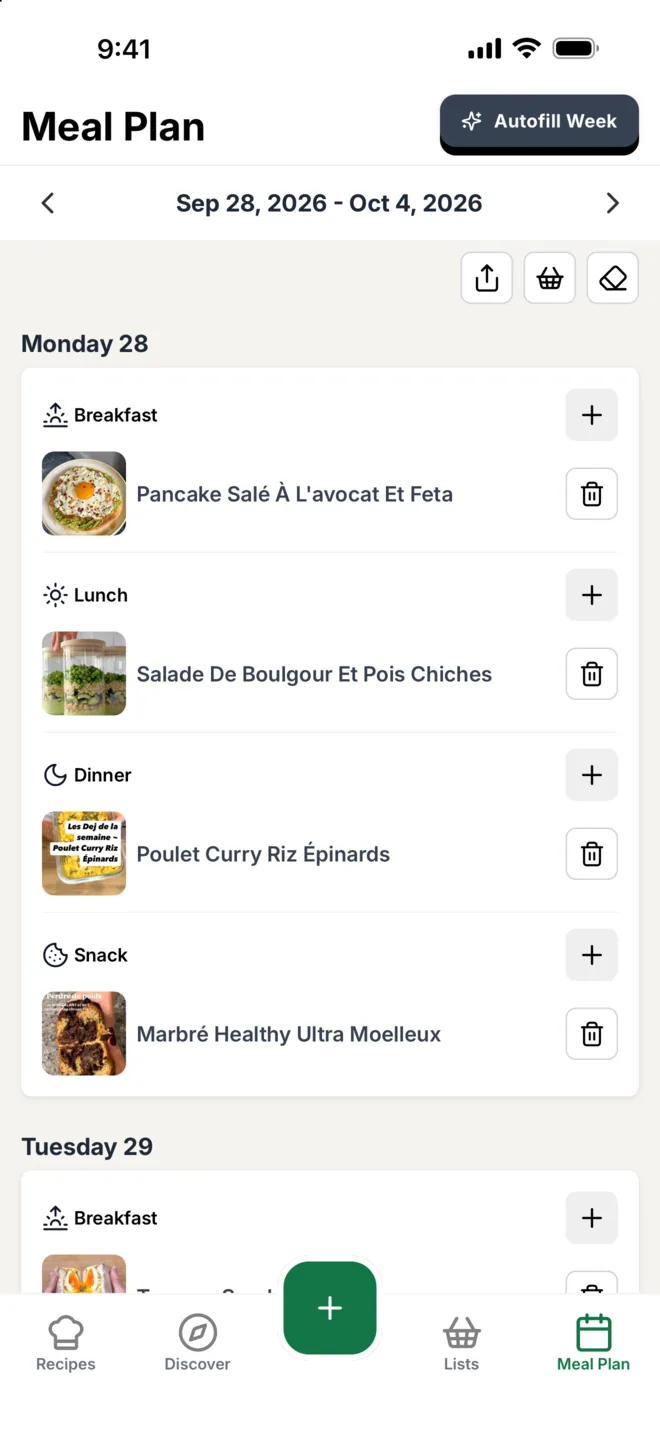
Once you have chosen the dinners, use the Citron recipe app to place your saved recipes on their cooking days.
Once your recipes are saved, you can place them on Citron's meal plan, from breakfast to dinner. Planning by hand is free. Your grocery list fills itself in from your plan: ingredients sorted by aisle, amounts added up across recipes.Check the shopping quantities against your portion notes. A later meal made from reserved food does not need the same ingredients bought again. Add breakfasts, other lunches and the backup dinner to your shopping list, then subtract what you already have.
The free plan includes 5 imports a week, refilled every Monday, and placing your recipes on the meal plan yourself.Start with a familiar recipe you want to cook next week.


Frequently asked questions
How do I start meal planning for a family?
Check who will eat at home each day and how much time you have before dinner. Put a familiar meal in each cooking slot, assign any leftovers to a specific meal, then check the ingredients against your pantry. Keep one backup dinner available for a night that changes.
How many portions should I cook for a family of four?
Start with how much your household usually eats of that particular recipe. If four recipe servings normally cover dinner and you want two similar lunch portions, plan six servings. Adjust for appetite and sides rather than assuming every child eats half an adult portion.
How do I meal plan for picky eaters?
Choose a shared meal with something familiar on the table. Keep sauce or toppings separate when that helps, and let each person choose from the foods served. Ask about preferences while planning so you can buy the needed ingredients.
Do I need to cook seven different dinners?
No. Count the nights you will eat at home, then decide which need fresh cooking and which can use reserved food, a freezer meal or a meal assembled from ready-to-eat ingredients. Decide which meal gets each leftover portion so lunch and dinner do not depend on the same food.
Can I put my family's recipes into a free meal plan in Citron?
The free plan includes 5 imports a week, refilled every Monday, and placing your recipes on the meal plan yourself. Start with recipes you already have saved and place them on the days you want to cook them.
Read next
Try the Citron app
Free to start, with limited imports and the core features.
- 4.9on the App Store
- 4.8on Google Play